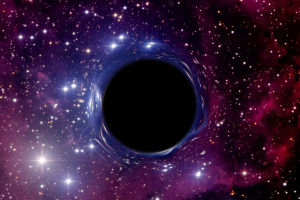
Black holes are among the most fascinating objects in the universe. These invisible cosmic regions exist at the centers of many galaxies, including the Milky Way, where a supermassive black hole influences the motion of nearby stars and gas through its extreme gravitational pull.
Over the past century, scientific research has greatly improved our understanding of black holes. However, one of the biggest unanswered questions remains what happens to matter after it crosses the event horizon.
Although no spacecraft or human has ever entered a black hole, modern physics offers strong theoretical insights. By combining astronomical observations with general relativity, scientists continue to build a clearer picture of these extreme environments.
The Event Horizon: The Boundary of No Return
A black hole is not a physical object with a surface. It is a region of space where matter has been compressed into an extremely small area, creating gravity so strong that nothing, including light, can escape once it crosses a boundary known as the event horizon.
Outside this boundary, escape is still possible if sufficient energy is available. Inside it, all possible paths lead inward toward the center.
In the case of very large supermassive black holes, an object may cross the event horizon without immediately noticing anything unusual. There is no solid surface or visible barrier, and the most extreme effects occur deeper inside.
Time Near a Black Hole
One of the most unusual predictions of modern physics is that time does not pass at the same rate everywhere in the universe. Near a black hole, gravity becomes so strong that time slows down relative to regions with weaker gravity.
To a distant observer, an object falling toward the event horizon appears to move more slowly as it approaches the boundary. Light from the object becomes increasingly stretched and eventually becomes undetectable.
From the perspective of the falling object, however, time continues to pass normally. This difference occurs because gravity affects the flow of time itself, not just motion through space.
Extreme Forces Inside
As an object moves closer to the center of a black hole, gravitational forces change dramatically over very small distances. The side of the object closer to the center experiences a stronger pull than the opposite side, creating strong stretching effects known as tidal forces.
In smaller black holes, these forces become extreme even before reaching the event horizon, stretching objects into long thin shapes. In larger supermassive black holes, the event horizon can be crossed before these forces become destructive. However, deeper inside, the forces eventually become strong enough to break apart any known structure.
This process is sometimes described as spaghettification due to the extreme stretching effect.
The Singularity Problem
Current mathematical models suggest that all matter falling into a black hole moves toward a central region called the singularity.
At this point, density and gravitational effects become so extreme that existing physical theories can no longer accurately describe what happens. Space and time are thought to behave in ways that are not yet fully understood.
Scientists believe that a complete explanation will require a unified theory that combines gravity with quantum physics. Until such a theory is developed, the true nature of the singularity remains unknown.
How Black Holes Become Visible
Although black holes themselves do not emit light, they can be detected through their effects on nearby matter. Gas, dust, and stars that approach a black hole often form a rapidly rotating structure around it.
Friction and gravitational heating within this structure raise temperatures to extremely high levels, causing the surrounding region to emit powerful radiation across multiple wavelengths.
In some cases, a star passing too close to a black hole is torn apart by gravitational forces. The resulting debris forms a temporary glowing structure that allows scientists to observe black hole activity indirectly.
Role in Galaxy Evolution
Black holes play an important role in shaping galaxies. Nearly every large galaxy contains a supermassive black hole at its center.
As these black holes grow by attracting surrounding matter, they can release large amounts of energy into their environment. This energy can influence the surrounding gas, affecting how new stars form within the galaxy.
Over long periods of time, this interaction between black holes and their host galaxies contributes to the structure and evolution of the universe.
Black holes remain one of the most powerful and mysterious phenomena in the universe. They shape space, influence time, and play a major role in the evolution of galaxies. Despite significant scientific progress, the deepest regions inside black holes are still not fully understood. Ongoing research in physics and astronomy continues to bring us closer to answering these fundamental questions.